
BIRD FLU: New Threat to Chicken Supply?
It seems a long way from finding two dead birds on WA’s scenic south coast to a national shortage of chicken, but bird flu’s threat to the nation’s $10bn poultry industry is now upon us.
The discovery of the initial two dead seabirds in the west, followed by a third in SA and a suspected fourth NSW victim of the deadly H5N1 strain of bird flu has biosecurity experts on high alert.
Australia’s poultry business produces half of the animal protein eaten in this country.
The new strain of avian flu is highly lethal to chickens, turkeys and quail while other commercial poultry species such as ducks can be silent carriers, spreading the disease without displaying symptoms.
Vet and honorary professor with the Australian National University, Dr Robyn Alders, warns that, unlike earlier bird flu strains, the H5N1 virus can be spread by a wider variety of wild animals and potentially even feral, pest or domestic animals.
If this bird flu strain gets into commercial chicken farms, it would mean millions of birds will be removed from Australia’s poultry supply-chain. Also, the costs of decontaminating and restocking the nation’s farms could see poultry and egg prices soar in the future.
Western Australia’s Chamber of Commerce and Industry chief executive, Will Golsby said: “An outbreak would likely require a farm to be closed for several months. Farmers would then need to source new chickens, grow them to productive size and navigate re-entry to markets and supply chain.”
For the moment, butchers will need to reassure consumers that it remains safe to eat poultry meat and eggs that have been handled and cooked properly.
The Australian Chicken Meat Federation maintains that: “Regardless of whether avian Influenza exists, chicken meat is safe to eat if it is cooked properly.
“The Australian Department of Health, the World Health Organisation and the United Nations Food and Agriculture Organisation (FAO) have confirmed that avian influenza is not a food safety issue and does not affect the food chain in this country.
“Avian influenza does not survive cooking temperatures. Furthermore, Australia’s emergency disease response protocols ensure that if there is an avian influenza outbreak in Australian commercial chicken flocks, that the risk of infected chicken meat entering the market is negligible.”
Addressing human health concerns, the federation has stated: “It is extremely rare for strains of avian influenza virus that cause disease in poultry to also cause disease in humans. However, some strains of H5 and H7 avian influenza viruses found overseas have been able to occasionally infect people, but this is rare, and requires very close physical interaction with infected birds. The avian influenza virus does not infect humans easily, and it does not transmit efficiently from person to person. The World Health Organisation (WHO) states that the likelihood of sustained human-to-human transmission of these viruses remains low.”
The official government response, posted on the bird flu website https://www.agriculture.gov.au/campaigns/birdflu is: “There is no evidence of infection in poultry or the wider agriculture industry. The risk to human health remains low.”
Chicken meat producers are working to prevent the spread of the deadly virus through their flocks. In WA, Inghams has blocked non-essential access to farms and is seeking permission from Canberra’s chief veterinary officer to bring its free-range flocks indoors.
In a statement to the Australian Stock Exchange, Australia’s largest poultry producer said it had “moved to a state of heightened biosecurity vigilance to mitigate against any potential risks.”
The SA Environment Minister Emily Bourke said state authorities were ready to mobilise testing while NSW has established an emergency facility at Orange in the state’s central-west to monitor any outbreak.
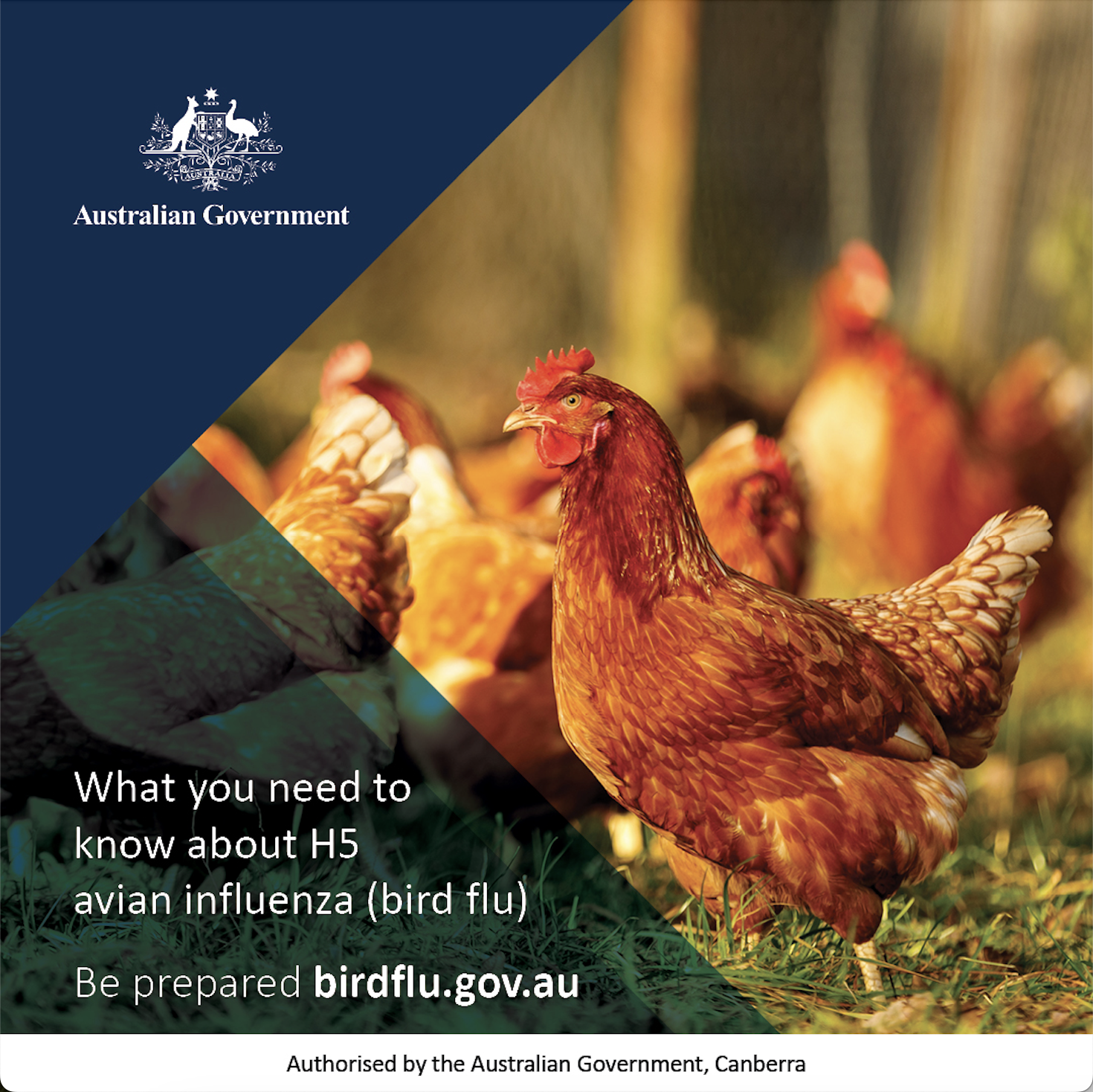
One of the bird flu campaign posters produced by the Australian Government.
According to Jose Quinteros, lecturer in poultry health at the University of Sydney, if there remain no confirmed cases in commercial facilities, there will be no impact on the supply or prices of eggs and chicken meat. “Right now, it’s reasonable for Australia’s poultry farmers to be highly vigilant. But we shouldn’t get carried away and panic,” he said. “Australian authorities have had a long time to prepare for a possible outbreak and develop plans which are now being put into place.”
Australia successfully contained and eradicated the less-deadly H7 bird flu outbreaks in 2024 and 2025 by culling about 2.4m birds, amounting to about 10% of Australia’s egg layer flock and leading to a retail price hike. That outbreak was believed to have spread from wild ducks.
According to the World Organisation for Animal Health, the more-deadly H5 virus is responsible for the deaths of 140m farmed birds globally, either culled or died from the disease, since January last year.
In Europe, some free-range flocks have been brought indoors to minimise the risk of contamination from wild birds.
Rabobank, in its latest global poultry outlook reports: “Disease risks in the global poultry sector remain elevated. Highly pathogenic avian influenza (HPAI) continues to circulate despite a seasonal decline in Europe after an intense winter. In recent months, more than 2500 HPAI detections have been discovered across 32 European countries. The United States reports similar trends with ongoing spillovers into poultry and other species.
“Meanwhile, Asia, the Middle East and Africa face more endemic circulation linked to live bird markets and backyard production systems.”
Australia’s response to any outbreak in commercial flocks would be to curb potential infection pathways and impose quarantine and movement controls, as well as flock culling and disposal. Emergency vaccination could be considered although at this stage, Federal Agriculture Minister Julie Collins, has said that vaccines would be primarily for threatened native wildlife.