Australia meat processing still most-costly
Australia continues to have the most expensive meat-processing among its main competitors – a reason why meat wholesale costs stay stubbornly high.
The industry-benchmark ‘Cost-to-Operate Report’ finds that Australian processing costs have officially risen by up to 58% over the past nine years, significantly higher than the CPI.
However, it warns that the global disruptions of the past six months could see prices up to 73% higher.
The summary notes that since the data was collected in December 2025, the Australian Manufacturing Input Price Index has risen by 10.7%. Also, since the analysis was completed, processor operating costs have further risen as ongoing conflict in the Middle East disrupts supply chains for both inputs and outputs such as fuel, packaging and shipping costs.
The August 2026 report suggests current processing costs of $587.58 for cattle and $70.34 for sheep and lambs. This represents a rise of 63% and 73% in the last decade respectively.
Using only the December 2025 data, the report finds that official beef processing costs reached A$531 per head (up 47%) in 2024/25 (excluding livestock supply) while the equivalent sheepmeat processing cost rose to A$64.31 per head (up 58%).
By comparison, beef processing in the United States was A$527, New Zealand A$519 and Brazil A$290 per head. For sheepmeat, New Zealand’s cost was A$63.69 per head.
Beef processing costs across Australia, New Zealand and USA have converged at around A$500 per head with difference in average carcass weight generating cost variation when measured per kg. Costs were marginally lower for grass-fed beef cattle.
Brazilian beef processors continue to incur lower costs per head from increased carcass weight through supplementary feeding.
Data used for the analysis was collected from 28 Australian processors in December 2025 to reflect 2024/25 figures. The survey providing coverage of approximately 57% of the total cattle slaughter and 34% of the sheep/lamb slaughter.
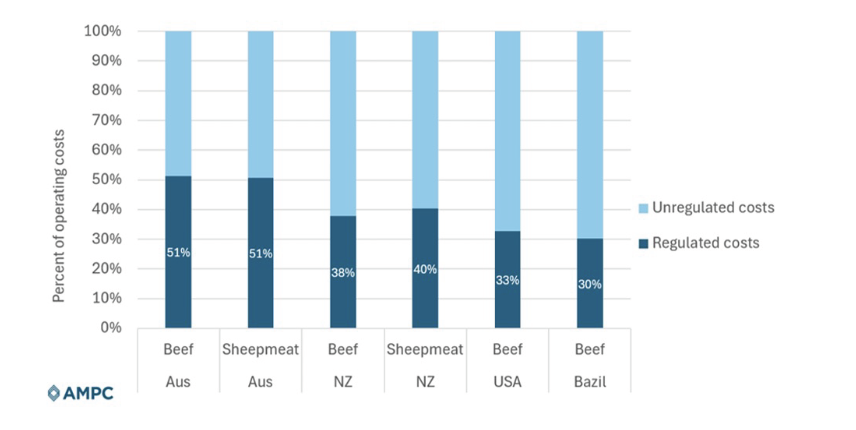
Australian processors face the highest level of regulation, with about half of their operational costs subject to regulation, compared with 40% in New Zealand and roughly 30% in the United States and Brazil.
The report noted that Australia’s regulatory component has remained largely unchanged since the last audit nine years ago.
The Australia, the main cost increases were in transport, repairs and maintenance, and registration and certification.
Among the items to have decreased were labour which, while increasing from A$210.94 per head (beef) to A$268.45 since 2015/16, now comprise 50.5% of total costs, rather than 58.5%. The sheepmeat equivalent also saw a similar dip; although the per head cost rose from $22.45 to $33.55, the percentage of over costs felt from 55.2% to 52.1%.
The reported noted ‘significant’ increases in costs for the USA and Brazil since the original analysis, “more so in terms of costs per head than in costs per kg, reflecting increased slaughter weights in both countries”.
It continued: “The key driver of these increases has been labour costs. The regulatory component has been largely stable. except for a reduction in Brazil reflecting energy deregulation.”
The Australian Meat Processing Corporation (AMPC)-backed study was undertaken by Dr Selwyn Heilbron.
The study also found that the average number of cattle processed per day in Australia was about the same as a decade ago. However, the average number of sheep processed had increased by around 2000 head per day.
The study helps explain relative cost to operate (and the relative impact of domestic regulatory costs) compared with international competitors and updates the previous international cost comparison analysis of operational processing costs.
AMPC CEO Edwina Toohey said: “It is critically important for our industry to understanding of our competitive position on the global stage, particularly given the current uncertainty in market access and supply chains.”
Industry commentators have welcomed the report, but were less-thrilled with its findings.
Andrews Meat commented: “The startling analysis gives context and insight into the rising costs of red meat primary processing in Australia and what exactly has been driving costs upward since the last report’s release in 2018.”
Australian Meat Industry Council chief executive Tim Ryan said: “The industry needs actions and outcomes to stem the damage and ensure that the Australian meat industry remains viable and internationally competitive.”