
More beef is headed towards Australian eaters … but can they afford it?
National records are being topped as Australian beef production is forecast to exceed 3m tonnes carcase weight in 2026.
Adult cattle slaughter grew from 9.3m head in 2025 to 9.6m in 2026, with annual feedlot turn-off exceeding 4m head for the first time in 2025/26.
Specifically, grain-fed beef continues its march across the Australian marketplace with latest feedlot capacity totals exceeding 1.7m head.
The national lot-feeding conference in late September heard how consumers will be encountering more grain-fed product across the counters and the cooktops of Australia.
The 1200 attendees at the Gold Coast conference heard that, over the past five years numbers of cattle on feed have lifted 38%, capacity 23% and turnoff 13%, while grain-fed exports are up 42%.
However, addressing the Australian Lot Feeders’ Association (ALFA) BeefEx conference was economist Saul Eslake who warned: “People’s real incomes are stagnating because real wages are not keeping pace with consistently high inflation.
“Consumers can say: ‘As much as we want to eat more beef, we can’t afford to’, or ‘We can’t afford to eat the highest-quality beef and we’ll have to go to lower-quality beef’ and that may be a challenge to your industry.”
Brendan Tatt, chief operating officer, northern, for JBS Australia detailed the growth of grain-fed animals through the company’s processing plants. Its largest meatworks, at Dinmore near Ipswich, now handles about 8000 head of grain-fed animals a week. “I think that’s continuing and I think that’s really beneficial,” he said.
“People are looking for a more premium product,” he said. “We’ve morphed from the basic 100-days and we’re now putting animals into specific programs. We’ve got to feed animals long-term to put more marbling in them. It’s that marbling expression that makes more money.”
Mr Eslake detailed comparative price rises of different meats over the past decade; beef rose 42%, lamb 29%, pork 21% and chicken 17.5%. He also compared those price rises to the 27.7% CPI lift over the decade and the 25.4% increase in average earnings.
Mr Eslake continued: “High beef prices relative to the prices of other meats and relative to people’s incomes could result in lower per-capita consumption of beef in Australia and in some of the other countries which are important export markets for Australian beef.
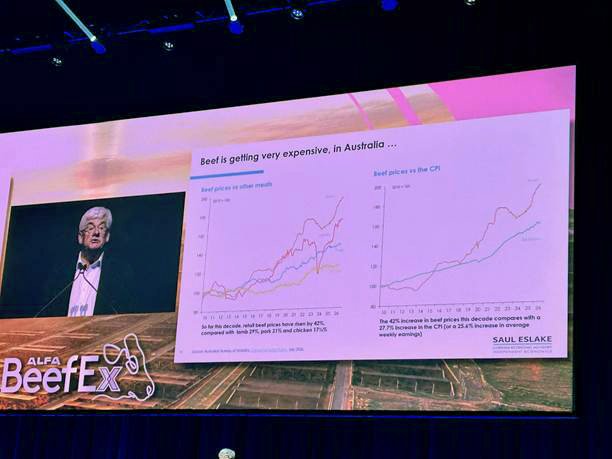
“It’s not going to happen in the next 12 months but it’s a potentially concerning trend over the next three to four years.”
The trend could coincide with a projected contraction of the national herd. MLA’s September Australian cattle industry update predicts numbers will ease to 9.2m in 2027 and 8.8m in 2028.
Meanwhile, another speaker addressing the ALFA conference, suggested the industry should consider the growth areas for its products.
“The real opportunities are around nutrition,” said Su McCluskey, chair of the Crawford Fund for Food Security. “It’s not just about eating more, but getting better nutrition.”
She noted the increasing use of cold storage in Asian nations – likely to benefit Australian beef exports – and the growth of nutritional foods specifically designed for the world’s aging consumers.
“And then there’s Gen Z which is seeking more convenience,” she added. “Sometimes what they’re demanding could be as simple as changing your packaging.”
Saul Eslake: “A potentially concerning trend”.
Su McCluskey: “Better nutrition”.